Monthly Archives: February 2010

Tidbits: Don’t Neglect The Neighboring Record

25 February 2010

Something that happens too often is that while researching your family tree we find ourselves looking at the image records over and over again. That’s something that I do frequently. I always prefer to review the original record when it’s not too inconvenient to do so. Original image records are one of the greatest things brought to the internet for genealogy research. Things that can be seen with your own eyes are the handwritten records of the census, voter registrations, draft cards, passport applications and more.

(more…)

International Search and Language Barriers

21 February 2010

A family tree researcher in the United States often overlooks or is unaware that we are capable of searching area specific search engines. Google, Yahoo and Bing along with many of the other search engines focus on the local relevance of searches as a high priority. While it is simple to locate information in California while you are sitting in New York, several of the results and sponsored links on the results page will still be local in nature because. As a genealogy researcher, however, you’ll be fascinated to learn that if you were searching for something in Ireland or Great Britain from New York there’s another secret method you should be trying. Your genealogy research in other countries can truly be attempted online.

Google has a dedicated site designed specifically for literally hundreds of places. Google.com is the most popular version of their search engine, serving most of the English speaking world – in the United States anyhow. There are various other Google search engines serving other countries that can be very helpful. For instance, if you’re searching for sites pertaining to the Walsh family but you’re really hoping to locate potential family members in Ireland you may be better off searching Google’s side dedicated to Ireland. So, keying in a search on Google.com for “walsh family tree” will net similar results as if you search the same terms from www.google.ie (Ireland). You will however, find a button to click at the top of the search results page that offers the same search but only pages from Ireland. The same goes for searching Google.co.uk (Great Britain), Google.com.au (Australia), Google.fr (France) and so on.

There are also search engines that exist in other countries (many available only in the foreign language native to that country). Russia has a search engine called Yandex. Another search engine called Buscapique covers several areas including Mexico and Central America, Brazil and several other areas. If you’re interested in seeking out other search engines specific to a region or a country you may just search your favorite search engine for “search engine Germany” or whatever area you’re looking within. A useful resource is the Big Search Engine Index which can be found at http://www.search-engine-index.co.uk/

Breaking through the language barriers can be difficult but one of the best tools around is Google Translate. If you use Google and have a custom home page then one option you have is to include Google Translate on your home search page. If you don’t have it then look it up. It has proven useful over and over again. It will translate entire paragraphs at once and even recognizes non-arabic alphabet letters and characters such as Chinese. Try this and you’ll quickly pick up on the main words that signal the type of record you’re looking for even if you don’t have any prior knowledge of the language.

Frequently you can also find English versions of websites. Look for forms of the word English on a site nearby the navigation items along the top or sides of a page and click on it.

Family Tree Form

19 February 2010

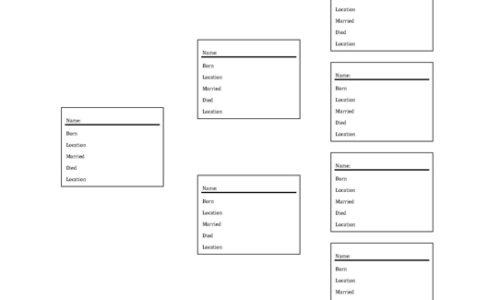
This family tree form is a horizontal chart that is designed to list three generations including a single individual, parents and grandparents of that individual. Space is provided at the left edge of the form for the youngest person in the group. (more…)

Genealogy Individual Proof Sheet

9 February 2010

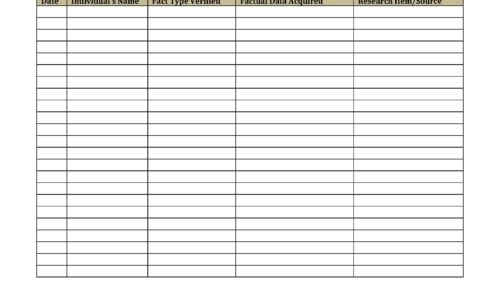
Use this free genealogy form to document individual, credible articles that help to form your proofs of identity, age, locations, and critical dates for ancestors you’re researching. In order to link certain individuals to an established family tree, standards indicate that you should have as many proofs of the individual’s important data as possible. (more…)

Genealogy Research Source Record

8 February 2010

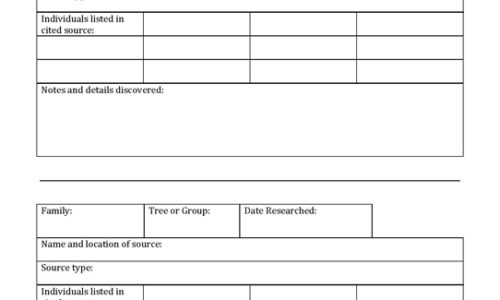
While performing research on a particular individual or family unit  it’s best to keep close track of which records have been sourced.  Birth, death, marriage and census records in particular are often referenced by the authority holding the information. (more…)